
Practitioner resource
The New York Frye and Federal Rule 702 Digital Evidence Admissibility Blueprint
November 1, 2026
(212) 561-586024/7: (800) 868-8189
A persuasive digital-evidence presentation begins before an expert report is drafted. Counsel needs a proposition worth proving, a source capable of addressing it and a record that explains how the examiner moved from source material to a conclusion. A device image, a vendor certification and an expert's credentials each address part of that foundation. None replaces the rest.
This blueprint organizes the technical work counsel may need when preparing evidence in New York state or federal court. It does not decide admissibility or supply a universal motion. The governing forum, claims, orders and particular evidence determine the legal analysis. Counsel should use current authorities and identify the required showing before commissioning an examination, rather than asking an expert to retrofit an already finished report to a different legal question.
Start with the proposition and the actual proponent
Write the proposed proposition in a complete sentence. For example, the issue may be whether a particular account accessed a file during a defined period, whether an export accurately represents a mailbox, or whether two media files differ in a way that matters to the dispute. Distinguish those issues from an accusation about who physically operated a device. Account, device and person attribution are related but separate questions.
Identify who will sponsor each part of the record. A custodian may explain how a system is used. A collector may explain acquisition and handling. A technical expert may explain methods and inferences. One witness may cover several roles if the foundation supports it, but the report should make those roles visible. Ask early what material will be offered, what conclusions are necessary and what alternative explanations must be addressed.
Separate New York Frye analysis from the factual foundation
New York's Frye inquiry addresses general acceptance of a relevant scientific principle or procedure. The Court of Appeals' discussion in Parker also distinguishes general reliability questions from the foundation for applying a method in the particular matter. A method described in published literature can still be misapplied to incomplete, altered or poorly identified source material. [PARKER]
Have the examiner explain whether the disputed conclusion depends on a novel method, an established technique or a combination of steps. Identify the professional community, validation material and limitations relevant to the actual proposition. Avoid presenting a general court reference to digital evidence as approval of every tool version or every inference. Counsel should determine whether a hearing, supporting declarations or a narrower presentation is appropriate.
Address federal Rule 702 before treating objections as weight alone
Under the current federal rule, the proponent must demonstrate to the court that the specified admissibility requirements are more likely than not satisfied. The rule addresses helpful specialized knowledge, sufficient facts or data, reliable principles and methods, and a reliable application reflected in the opinion. It is not enough to label every methodological concern a matter for cross examination. [FRE]
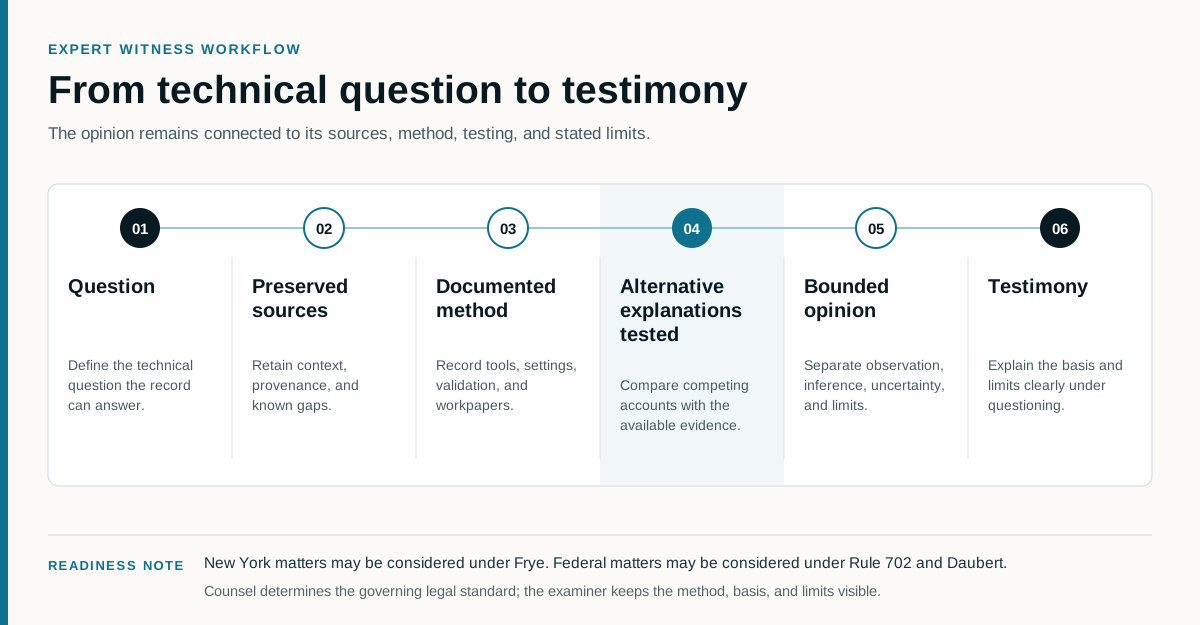
Prepare a foundation table with one row for each proposed opinion. Identify its factual inputs, examination method, validation basis, application steps and limitations. Then identify the witness who can explain them. Distinguish a missing fact from a disputed interpretation of an available fact. If the available record supports only a narrower opinion, revise the opinion before testimony instead of relying on the audience to infer the limitation from an appendix.
Preserve the source, acquisition record and history of handling
Record the source identity, collection authority, operator, date, time basis, tool and version, method, filters, errors and outputs. Retain verification values where the acquisition method supports them. Explain whether collection was physical, logical, targeted, live or provider generated. A cryptographic hash helps compare specified bytes; it does not establish that the original content was truthful or that every relevant source was collected.
Maintain a handling record from receipt through examination and production. Identify transfers, working copies and access to the material. When a source was changed during necessary live collection, document the reason and expected effect. Preserve earlier versions of exports and reports so a later correction does not erase the history. Counsel can then assess a specific exception rather than discover at deposition that a general custody statement concealed an undocumented step.
Authenticate the offered item, not just the examination computer
Federal Rule 901 concerns evidence sufficient to support a finding that an item is what its proponent claims. For electronic records, the supporting account may involve a knowledgeable witness, distinctive characteristics, a reliable process or other applicable evidence. Identify what the proponent says the item is before choosing the foundation. A screenshot of a message, a native message and a provider export present different questions. [FRE]
Collect the context needed to explain the offered item: account identifiers, conversation boundaries, attachments, available metadata, source location and the relationship to a preserved export. Separate an exhibit prepared for presentation from the underlying data. Retain the steps used to create a timeline, crop an image, transcribe audio or select messages. A clean courtroom graphic should not obscure edits, omitted context or the distinction between a demonstrative and the offered source record.
Use certifications for the questions they actually address
Federal Rule 902 contains provisions for certain certified electronic-process records and copied electronic data. Their conditions, certification and notice requirements must be considered by counsel. A qualifying certification can address an authentication issue without resolving every question about relevance, hearsay, attribution, expert methodology or the meaning of the content. [FRE]
Ask the provider or collector what facts can be certified and what supporting material exists. Confirm that the certificate identifies the actual data and process offered, rather than a product category or an unrelated export. Calendar any notice and inspection requirements under the applicable rule and order. If a certification is unavailable, identify the witness or other foundation counsel may need while the necessary people and records can still be obtained.
Treat hearsay, completeness and preservation as separate workstreams
Authentication does not automatically establish a hearsay exception. Business use of a system does not automatically make every statement stored there a business record. Counsel should identify the purpose for which each statement is offered, the relevant rule and the supporting witness or certification. Technical staff should preserve the facts needed for that analysis without declaring the legal result. [FRE]
Similarly, an item may be technically authentic while representing only part of a conversation or a limited export. Record collection filters, time ranges, pagination, excluded locations and missing attachments. Where lost ESI is relevant, preserve the facts needed for the governing preservation analysis, including reasonable steps taken and possible replacement sources. Do not assume that a favorable authentication showing resolves a preservation dispute. [FRCP]
Make the method reproducible at the appropriate level
Retain examination notes, relevant queries, processing options, scripts, tool versions and the records used to reach each material finding. Explain how source times were interpreted and normalized, including time zones, clock differences and conversion assumptions. Where a tool output cannot be independently reproduced, identify the constraint and any corroborating method instead of describing the result as universally repeatable.
Examine alternative explanations that bear on the proposition. A file timestamp may change through normal system behavior. A successful account event may not identify the person at the keyboard. A log gap may reflect retention rather than deletion by the disputed actor. Explain which alternatives the available data can test and which remain unresolved. This gives counsel a defensible boundary for the opinion and a realistic account of the questions an opposing expert may raise.
Keep automated analysis and AI assistance reviewable
If automated classification, transcription, extraction or AI assistance contributes to the work, record its purpose, input boundaries, relevant version and the human review performed. Preserve the underlying evidence and the means to check material outputs. Avoid uploading protected source material to an external service without an approved handling arrangement.
Distinguish an automated lead from a validated finding. An algorithm's confidence label is not itself a legal standard or a substitute for examining the source. If a result depends on a model or service whose behavior cannot be inspected, state that limitation and consider whether a more direct method can address the disputed proposition. The expert must be able to explain the opinion and its actual basis, not simply repeat the output of a tool.
Build the pretrial evidence packet and rehearse its limits
Organize the packet around the proposed findings. Include the source register, handling records, method and validation explanation, key underlying records, alternative explanations, exhibits and a list of missing material. Keep current CV and experience information available without implying that a previous court appearance guarantees qualification in the present matter. Counsel decides disclosure strategy, privilege issues and the motion or hearing record.
Before the deadline, ask the examiner to explain each opinion in ordinary language and point to the supporting source. Test whether a reviewer can follow the chronology and identify the distinction between observation and inference. Resolve inconsistent exhibit labels and unexplained date conversions. Where the foundation remains incomplete, identify the missing fact, the person who may supply it and the decision that cannot yet be supported. A narrower, well explained opinion is more useful than a broad conclusion whose limits emerge only under questioning.
Information Gathering Q&A Checklist
Use this Q&A with the people who own the systems and the relevant legal or business decisions. Mark unknown or not applicable answers explicitly. Record an owner, a confirming source and the date. The public guide-request form asks for your email, not the answers below.
Do not write passwords, recovery keys, unlock codes or authentication secrets here. Record whether authorized access is available, who controls it and how a secure handoff can be arranged. Keep completed copies in the location counsel or the company approves. Do not send a completed record containing sensitive account or employee details through a public contact form.
- Who is directing the matter and who can authorize technical access?
Identify directing counsel, the business decision maker, the IT security owner and any outside administrator. Record the immediate deadline, relevant period and known preservation risk. An employee's possession of a device or an administrator's ability to access an account does not by itself settle the authorized examination scope.
Answer:
Owner, source, date and unresolved questions:
- Who provides the email service and who administers it?
Identify Microsoft 365, Google Workspace, an internal Exchange environment, a hosted service or a combination. Record the tenant or organization reference, relevant domains, mailbox owners, aliases, shared mailboxes and the MSP or administrator responsible. Identify available preservation and export permissions and any licensing question that needs confirmation.
Answer:
Owner, source, date and unresolved questions:
- Does the company have archiving, backups or preservation holds in place?
Name each service and distinguish an archive or journal from a backup, a retention policy and a matter specific hold. Identify what each covers, the available dates, deletion or rotation rules and who can export or restore records. Record whether preservation has actually been verified, rather than treating the existence of a subscription as proof of coverage.
Answer:
Owner, source, date and unresolved questions:
- Does the company supply the computers or do employees use their own?
Record company owned, personally owned, leased and shared equipment separately. Identify the assigned user, operating system, asset or serial reference and present location. Note any employee owned computer used for business and the applicable access agreement. Company ownership and permission to examine particular personal material should not be assumed to be the same.
Answer:
Owner, source, date and unresolved questions:
- Are mobile devices company owned, employee owned or a mixed arrangement?
Identify the phone or tablet, assigned user, model and operating system where known, and who currently holds it. Distinguish the owner of the handset from the owner of the cellular service account. Record whether work data is separated into a managed profile and whether a replacement, return or wipe is already scheduled.
Answer:
Owner, source, date and unresolved questions:
- Whose Apple, Google or Samsung account is registered or signed in on each phone?
Record each relevant account as personal, company controlled or unknown, and identify who can lawfully arrange access. For Apple devices, note any organization enrollment and known Activation Lock status separately from the signed in Apple Account. For Android devices, distinguish personal and work profiles and note relevant Google and Samsung accounts separately. Do not sign out or reset an account to answer this question. [S14] [S15]
Answer:
Owner, source, date and unresolved questions:
- Does the company use MDM and what does it actually manage on these devices?
Name the management service, administrator and enrollment mode, including supervision or work profile details where applicable. Record the last known device contact and any pending retire, lock or wipe command. A device appearing in a management console does not establish access to every personal application, message or backup. Preserve the management record without issuing a command merely to test capability.
Answer:
Owner, source, date and unresolved questions:
- Can the company recover the BitLocker or other encryption keys for each relevant computer?
Ask whether recovery material is actually available for the identified device and drive, where it is escrowed and who has authorized retrieval permission. Possible locations include Microsoft Entra ID, Active Directory or another approved store. Note FileVault or other encryption separately. Do not assume that MDM enrollment guarantees key availability, and do not place the key itself on this record. [S13]
Answer:
Owner, source, date and unresolved questions:
- Who controls identity, administrator access and multifactor authentication?
Identify the identity provider, relevant privileged accounts, outside administrator and person who can approve an export or collection. Note access dependencies such as an unavailable administrator or authentication device without recording secrets. Shared or delegated access should be identified because account activity may require additional evidence before it can be attributed to an individual.
Answer:
Owner, source, date and unresolved questions:
- Which cloud storage, collaboration and messaging services contain relevant work?
Identify shared drives, Teams, SharePoint, OneDrive, Slack, Google Chat and other platforms actually used for the relevant work. Note external ownership, linked documents, personal accounts used for business and any unsupported or unavailable source. A mailbox export should not be assumed to include the contents of every linked file or separate conversation.
Answer:
Owner, source, date and unresolved questions:
- What activity logs and endpoint records are available now?
Ask the responsible administrator which email, identity, endpoint, cloud sharing, USB, security and data protection records exist for the relevant period. Record actual date coverage, export permissions, known gaps and the next expiration or rotation point. Enabling a logging feature today should not be described as recovering activity that was never recorded.
Answer:
Owner, source, date and unresolved questions:
- What has already changed on the devices or accounts?
Record password resets, access restrictions, account deletions, mailbox conversions, software installations, cleanup activity, repairs, cloud sync changes and any device reset or wipe. Identify who acted, when and why. Include informal handling or earlier collections so the examiner can distinguish relevant historical activity from changes made during the response.
Answer:
Owner, source, date and unresolved questions:
- What exact factual proposition is the evidence intended to support?
Separate the offered item, its source, the proposed inference and the witness who can explain each.
Answer:
Owner, source, date and unresolved questions:
- Which forum, orders, disclosure dates and evidentiary questions does counsel identify?
Record counsel-approved requirements without treating this worksheet as a legal determination.
Answer:
Owner, source, date and unresolved questions:
Primary sources and further reading
Prepared November 1, 2026. Sources explain the general framework; applicability, licenses, available records and legal requirements vary. This guide is technical preparation, not legal advice or an assurance of compliance or admissibility.
- FRE: Federal Rules of Evidence, current December 1, 2025 edition
- FRCP: Federal Rules of Civil Procedure
- PARKER: Parker v Mobil Oil Corp., New York Court of Appeals, 2006
- S13: Microsoft BitLocker recovery overview
- S14: Apple guidance on Activation Lock and device management
- S15: Android Enterprise guidance on work profiles