
Plan AI security work with your New York security team
Introducing an AI assistant or agent can require input from security, application owners, data administrators and the business team. We help define the local assessment contacts, the intended use and the information or tools the application can access.
Bring the workflow, user roles, connected systems and rollout date. The scope can examine data permissions, agent actions, approval steps and logging. Controlled testing is coordinated with the system owner and produces findings that engineers can act on.
For a regional organization operating across offices, identify which controls are shared and which applications have their own owners. That division helps organize the work and the executive and technical reporting.
Can a New York security assessment include an AI application?
Yes. We can scope authorized AI application review and controlled testing around its data, permissions, connected tools and intended users. We coordinate with the owners responsible for the system and remediation.
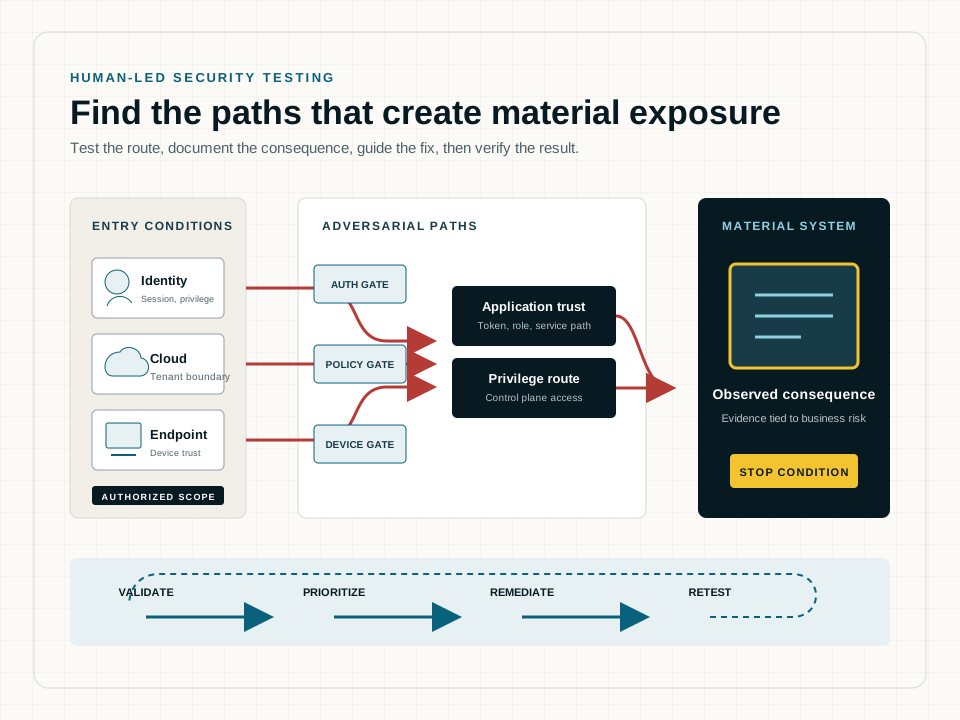
GDF works with security leaders, IT managers, counsel, and risk owners on material risk reduction. Engagements focus on systems that support revenue, regulated data, public services, and operational continuity. Scanning can inform the work, but human analysis decides whether weaknesses combine into a credible route to impact.

Start with assets and consequences
A severity score does not explain business exposure. The team identifies critical identities, applications, data stores, administrative paths, remote access, third parties, and recovery dependencies. Testing is then designed around the ways an adversary could reach or disrupt them.
For New York-regulated financial organizations, work can produce technical evidence useful to a 23 NYCRR Part 500 program. Counsel and compliance officers decide whether a control meets a legal requirement. GDF tests the control and documents the observed result.
Services that connect finding to fix
Human-led penetration testing, vulnerability assessment, application review, cloud and identity assessment, incident readiness planning, and response can be combined or commissioned separately. Findings name the affected asset, exploit conditions, likely consequence, supporting evidence, and owner. Vulnerability remediation guidance is practical enough for a system team to act on.
- External, internal, cloud, wireless, and application testing
- Identity, privilege, segmentation, and administrative-path analysis
- Ransomware and business email compromise readiness
- Incident containment, evidence preservation, and analysis of likely initial-access paths and contributing conditions
- Point-in-time retesting and residual-risk records for material findings
Coverage across identity, cloud, network, and application paths
Modern attack paths cross control owners. An exposed application can lead to a workload identity, cloud role, secrets store, management plane, and sensitive data without relying on a traditional internal network exploit. A help-desk workflow or stale vendor account can bypass controls that look effective on an architecture diagram.
GDF maps external exposure, authentication, authorization, privileged roles, remote access, service relationships, segmentation, application logic, monitoring, and recovery dependencies as one system. Testing depth and evidence collection are adjusted to production risk, available test environments, data-handling rules, and the client's approved stop conditions.
- Internet-facing assets, domains, applications, APIs, and remote access
- Microsoft 365, Entra ID, AWS, Azure, and administrative identity
- Internal trust, privilege, network segmentation, and management services
- Application logic, source code, secrets, integrations, and deployment paths
- Logging, alerting, backup, restore, and response decision points
Readiness, response, and remediation form one operating record
Incident readiness planning tests whether contacts, authority, logging, collection access, isolation procedures, recovery priorities, backups, outside providers, and communications work under time pressure. A tabletop is useful only when it exposes a decision gap and assigns a correction that can be verified.
During an event, the same source map supports containment and scoping. Afterward, evidence-supported findings about likely initial-access paths and contributing conditions inform hardening and retest work. This continuity keeps response evidence, remediation ownership, accepted exceptions, and current validation status from being separated across unrelated reports.
Reporting for decision makers and technical owners
Reports separate validated exposure from tool output. Executive summaries explain material consequence and decision points. Technical sections include reproducible evidence, affected scope, remediation options, and the date, conditions, and approved boundaries of any retest. A passing retest addresses that scope at that time; it is not a statement that adjacent paths or the wider environment are free of risk. Sensitive exploit detail is controlled rather than placed in broadly circulated slides.